


How Michigan's Move Over Law Applies to a Recent Lansing Semi-Truck Crash
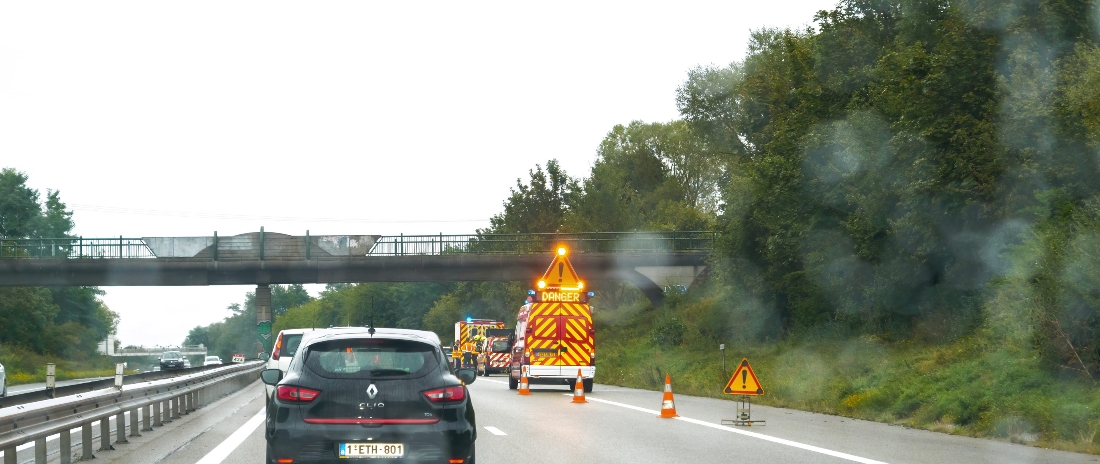
A recent I-69 crash involving multiple semi trucks and emergency vehicles highlights why Michigan’s Move Over law matters in real liability analysis. When a police cruiser or fire truck is stopped with emergency lights activated, the law creates a clear duty for approaching drivers to slow down and, when possible, move over. When a commercial truck strikes an emergency vehicle at an active scene, investigators and insurers tend to focus quickly on whether that statutory duty was followed and whether the driver adjusted for conditions like ice.
Michigan’s Move Over Law and What It Requires
Michigan’s expanded Move Over law requires drivers to slow to 10 mph below the posted speed limit and yield their lane when passing stationary police or emergency vehicles on the side of the road. The purpose is to reduce predictable secondary crashes in roadside response situations, where responders and disabled vehicles are exposed to high speed traffic.
In a liability evaluation, the Move Over law matters because it establishes a specific safety expectation. If a driver could have slowed and moved over but failed to do so, that can become strong evidence of negligence depending on the surrounding facts.
What Happened in the I-69 Incident
According to the report, the crash occurred on I-69 in Shiawassee County just before midnight on Saturday, February 21, 2026, about halfway between Lansing and Grand Blanc Township. A Michigan State Police trooper was responding to a crash when the patrol vehicle was struck by a semi truck that authorities said lost control due to ice, and the cruiser’s emergency lights were activated.
The report also states a Perry Fire Department truck was blocking the freeway as the crash was being investigated and it too was hit by a second semi truck, resulting in minor injuries to a firefighter. A third semi truck reportedly drove off the road shortly after, and the freeway reopened around 7 a.m. the following morning.
How the Move Over Law Fits into the Liability Analysis Here
This fact pattern is exactly the type of situation the Move Over law is designed to prevent: a clearly identifiable emergency scene with illuminated emergency vehicles and active response activity. In cases like this, legal analysis usually centers on whether the approaching commercial driver recognized the emergency scene in time to take the required precautions and whether lane movement was feasible given traffic conditions.
Ice complicates crash reconstruction, but it does not eliminate the need for speed adjustment. If road conditions are icy, the duty of caution typically increases because stopping distance expands and loss of control becomes more foreseeable. When the stated reason for the initial impact is loss of control due to ice, investigators often scrutinize speed choice, following distance, braking timing, and whether the driver began slowing early enough upon approaching visible emergency lighting.
What Evidence Typically Matters Most in a Case Like This
Where Move Over compliance is in question, liability analysis usually turns on objective data, including:
-
speed and deceleration before impact
-
lane position and whether a lane change was available
-
visibility and sight distance to the emergency lights
-
braking timing and stability indicators
-
dash cam or traffic camera footage when available
-
road condition documentation and weather context
In commercial vehicle cases, electronic data and scene measurements often become central because they help answer the key question: did the driver respond reasonably and in time to the emergency scene, given the conditions.
Why This Crash Highlights the Legal Standard on Highway Emergency Scenes
In situations where crashes occur near emergency vehicles, liability analysis often depends on detailed reconstruction of events, including vehicle speed, visibility conditions, lane position, and reaction timing. Because these factors must be evaluated together rather than in isolation, determining whether statutory duties were satisfied frequently requires careful review by an attorney handling Lansing truck accident claims who understands how commercial vehicle standards and roadway safety laws are applied in real investigations.

Other Insights


How Michigan's Damage Caps Quietly Shape Case Strategy

How Personal Injury Claims Are Evaluated in Lansing

Fentanyl a "Weapon of Mass Destruction" and Marijuana a Schedule 3 Substance After Executive Orders



Comments